


The markets will fluctuate daily based on the news flow and many
unpredictable events. The market’s movements in response to these
changes cannot be predicted. In the long run, markets respond to
economic growth, and the economy grows as the population grows, as
equipment wears out and needs to be replaced, and as new technologies
become available.
- We recommend that cash needed for known immediate / short – term expenses should be removed from the investment portfolio.
- Rolling 36 Month periods is the minimum timeframe to evaluate performance.

The markets are usually efficient. That is a fancy way of saying that the price of any stock on any given day reflects all the known public information about that stock. The price is the average of everyone’s opinion. Some people think the price should be higher, so they are buyers, and some think the price should be lower, so they are sellers. For this reason, trying to pick individual stocks that are undervalued is a guessing game. As news comes out, the market digests that new information almost instantly and prices adjust.
Risk and expected return are related. Because the stock market outperforms bonds and cash investments over the long haul, we expect that the more stock investments included in a portfolio the higher its return should be over time. Portfolios with a lower allocation to the stock market will be less volatile but will also be expected to produce a lower long – term return.

Taking the right type of risk is important. Taking the risk of being in the market drives your long –term expected results.
Because the market fluctuates with economic expectations, this type of risk is called “Systemic Risk.” We expect the more systemic risk you take, the more return you should expect over time.
Another type of risk, called “non-systemic risk,” is the risk associated with any individual company’s performance. A drug company can have a bad clinical trial, or an oil company can have an accident. Individual companies can go bankrupt, leaving their stocks worthless. Because the markets are efficient, choosing individual stocks does not provide more potential return, but does mean taking more risk. For this reason, we prefer portfolios built from broad, diversified funds rather than from stocks or bonds from individual companies.
Asset Allocation is much more important than Stock Selection. Asset allocation refers to how a portfolio is divided up between stocks and bonds, and how those broad categories are broken down into types of stocks and bonds. Research has shown that 94% of a portfolio’s return comes from this decision (Brinson, Hood and Beebower – Financial Analysts Journal – February 1995)
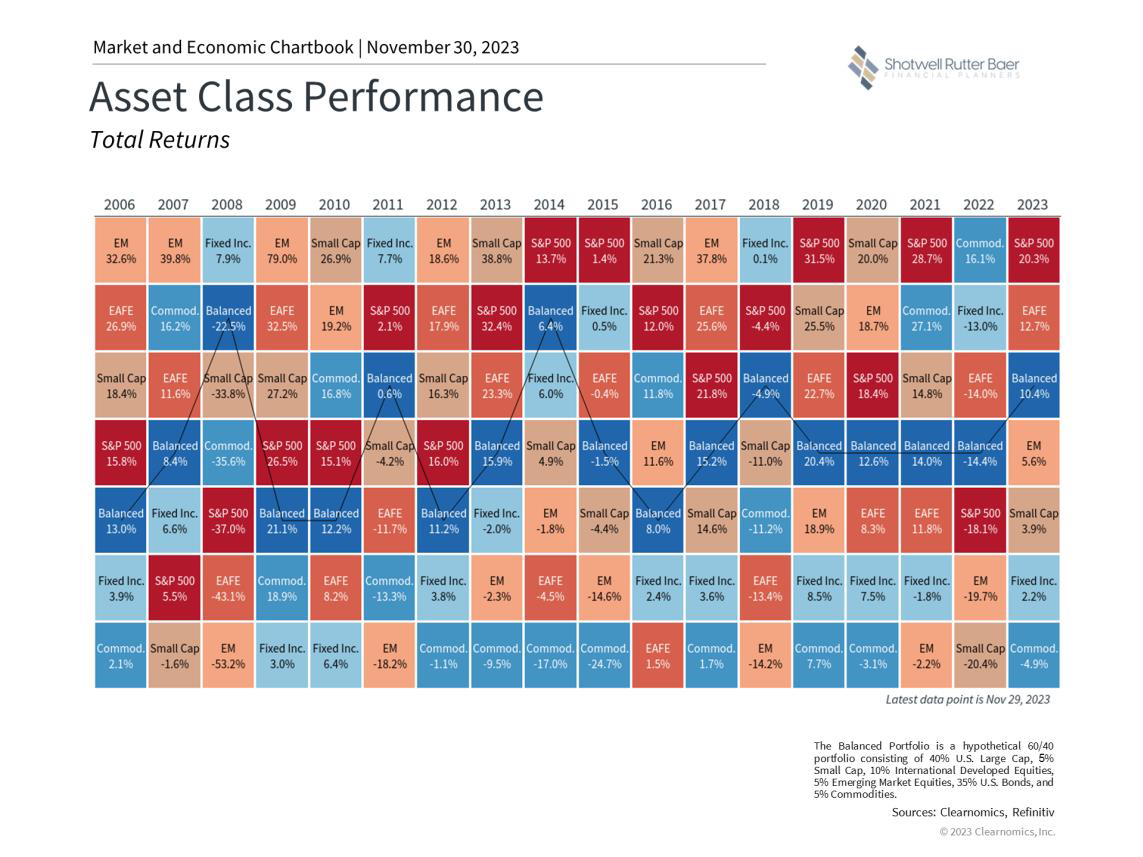
We believe in global diversification in any asset class where the
opportunity exists. The financial markets span the globe and are interconnected, and your portfolio should reflect that with broad, global exposure.
- We prefer hedging currency risk in fixed income, but do not hedge currency exposure in more volatile asset classes like equity or real estate.
- We start with the global market portfolio, and then tilt our models to match our preferred exposures.

We believe in regular rebalancing but infrequent trading. Rebalancing means returning your portfolio holdings to the target percentages assigned to the model.
- Regular rebalancing mitigates portfolio risk and creates a disciplined approach to selling assets that have risen beyond their targets and buying those that are down, compounding gains when those assets come back in favor.
- Infrequent trading means we generally do not replace managers based on short –term performance and rarely make tactical market adjustments. Limiting turnover reduces taxes and portfolio costs.
Portfolio Expenses are also important. Investment returns are only worth what you get to keep. Controlling expenses, means more return goes directly to investors. Because markets are efficient, active mutual fund managers, trying to pick winning stocks that will beat the market, rarely add consistent value when their fees are factored into returns.
- This leads us to focus on low –cost, passive or index funds and exchange traded funds.
- In addition to controlling the internal costs of the funds in a portfolio, it is also important to control trading costs.
Taxes Matter. Along with expenses, tax –efficiency makes a difference for non –retirement accounts.
- Active management can create capital gains taxes when portfolio managers change their stock holdings, and these taxes can further hamper returns. Building portfolios from low –cost passive mutual funds saves both expenses and taxes.
- Where appropriate we use municipal bonds for tax –free income and locate non-tax-efficient assets in retirement accounts instead of taxable accounts.
- We also limit the number of holdings in taxable portfolios and focus on low –turnover to avoid capital gains.
There are factors that can be identified which can lead to long –term outperformance. Instead of choosing individual stocks, focusing on groups of stocks with specific characteristics can lead to long –term outperformance.
- For example, smaller companies tend to outperform larger companies as a group.
- Value stocks, meaning stocks whose share price is lower than average when compared to their earnings, tend to do better than the stocks of companies whose share price is high relative to their earnings.
- Companies with higher profit margins tend to see their stocks perform better than companies with lower profit margins.
- In the bond market, this strategy means emphasizing investment –grade bonds as opposed to lower –quality bonds.
Complexity Does Not Mean Outperformance: Often simple answers are the best answers. Wall Street brokerage firms make a lot of money convincing investors that there are new strategies, so –called alternative investments, or other complex ways to invest that change the otherwise simple dynamic of investing in stocks for the long run. There is no free lunch in the investment world: if a particular investment plan offers higher returns for less risk, there is a cost somewhere, either in the form of fees and premiums or in lost liquidity, to make those higher returns possible.
- Non –Traditional or “Alternative” investments may be suitable in certain circumstances, but only after thorough due diligence. When appropriate, we generally recommend limiting these assets to 5% of a portfolio for each position and 20% overall.
Staying in invested over the long –haul, in a portfolio that is tax –efficient and cost –effective and takes the appropriate amount of risk for you and your goals is the key to long –term success.
