
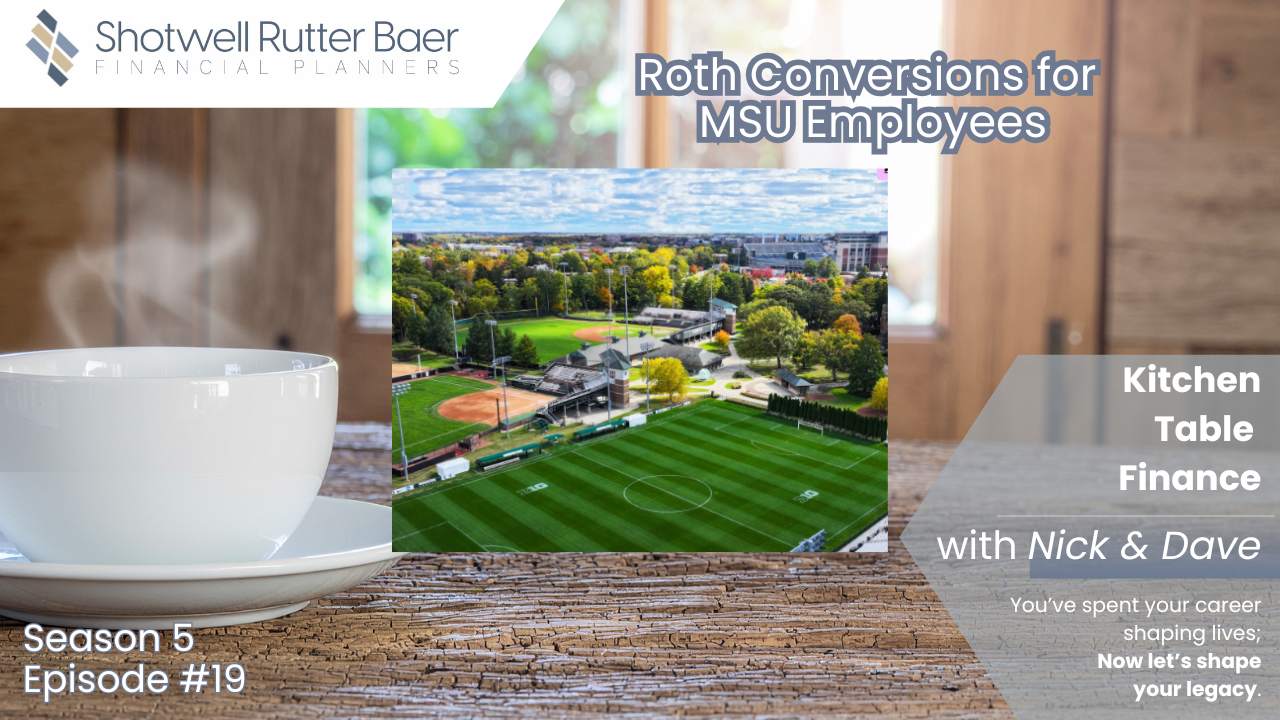

For longtime Michigan State University employees, retirement savings can often be heavily weighted toward pre-tax accounts. Until recently, MSU employees primarily made retirement plan contributions through pre-tax options. Add years of contributions, MSU’s university match, and investment growth, and those balances can become substantial.
That creates an important tax planning question as retirement approaches: When should you pay the taxes on those savings?
For over 25 years, we’ve specialized in retirement planning for Michigan’s university and state employees. We understand the intricacies of 403(b) and 457 plans through Fidelity (and beyond), TIAA contracts, and state healthcare transitions. We’ve guided many of MSU’s faculty and staff through the exact decisions you’re facing right now.
In Season 5, Episode 19 of Kitchen Table Finance, Dave Shotwell and Nick Nauta discuss Roth conversions and why they deserve attention from MSU employees preparing for retirement.
What is a Roth Conversion?
A Roth conversion moves money from a pre-tax retirement account into a Roth account. You pay income taxes on the converted amount today, while qualified Roth withdrawals can be tax-free later.
For MSU employees, there is an additional detail to consider. Michigan State now allows Roth contributions, but the plan does not allow employees to convert existing pre-tax plan balances to Roth within the plan. That can make IRA-to-Roth IRA conversions an important planning option after retirement.
Why Is This Important to MSU Employees?
Dave and Nick discuss the potential window between retirement and required minimum distributions. During these years, taxable income may be lower, creating opportunities to convert portions of retirement savings at potentially favorable tax rates.
They also explain why the decision involves more than comparing today’s tax bracket with a future tax bracket. Roth conversions can affect Social Security taxation and Medicare IRMAA premiums. They can also influence future required minimum distributions and taxes for a surviving spouse.
What Will I Learn in this Episode?
The episode covers inherited retirement accounts, including the 10-year distribution period that generally applies to many non-spouse beneficiaries. Dave and Nick also explain how Roth savings can provide more choices when deciding where retirement income should come from.
Listeners will also learn why paying conversion taxes with money outside the retirement account can sometimes improve the long-term math. The conversation covers the pro rata rule, conversion deadlines, state taxes, and the fact that Roth conversions cannot be reversed once completed.
The goal is not to convert as much as possible. The goal is to consider taxes across retirement and determine whether conversions could help reduce the average tax burden over time.
For MSU employees with years of pre-tax retirement savings, starting this conversation early can provide more planning choices before required minimum distributions begin.
Need Help Managing Your MSU Retirement Plan?
Contact SRB today at 517-321-4832 or email us at info@srbadvisors.com.
Don’t forget to subscribe to our YouTube channel for more bite-sized financial and retirement tips.
Resources
Specialized financial planning for MSU faculty and staff navigating the transition from campus to retirement.
https://srbadvisors.com/michigan-state-university-faculty/
Specialized financial planning for State of Michigan employees who want to make the most of their benefits and retire with confidence.
https://srbadvisors.com/state-of-michigan-employees/
Podcast: Play in new window | Download